Energy from Wastewater - Frequently Asked Questions
Why generate energy from wastewater?
Wastewater is available all year round and is characterized by a relatively constant temperature throughout the seasons, mostly between 12 °C and 20 °C.
By combining heat exchangers and heat pumps, the energy from waste water can be used for heating and cooling. Since about half of the energy requirement is used for heating and cooling, it is relevant to develop renewable energy sources. Since 2018, energy from wastewater has been classified as a renewable energy source at European level. Energy from wastewater has the potential to cover 10-14% of the heat demand in the building sector. The use of this environmental heat for heating is more efficient than using the outside air due to the higher temperature level in winter. In the summer, the waste water is cooler than the air. This and the good heat transfer properties of water enable energy from wastewater to be used efficiently as a renewable energy source for heating and cooling. By using energy from wastewater, CO2 emissions and operating costs can be reduced.


The use is diverse. Wastewater energy is primarily used to preheat hot water and to heat and cool buildings. But it is also used in industrial processes or can be used in the sewage sludge drying process at sewage treatment plants.
Heating and cooling with energy from waste water can be implemented in any building with a power requirement of 50 kW or more. This corresponds to about 40 residential units. There are hardly any upper limits, so properties with a heating and/or cooling requirement of more than 3 MW are already being supplied with waste water energy. Typical users are
- residential buildings and quarters
- hotels
- hospitals, health institutions
- retirement homes or dormitories
- shopping centers
- sports facilities
- industry and commercial enterprises
- and much more
Depending on the usage profile, the following requirements must be observed for “in-house systems” (primarily for hot water production):
- Available amount of waste water of at least 2-10 m³/day
- Waste water temperature 30°C or higher
- required power of 10-100 kW
To use the thermal potential of the sewer for heating and cooling buildings, the following basic requirements are necessary:
- a sufficiently large duct (DN 400 or larger)
- Available waste water volume >10 l/s
- Temperature >8ºC
- Distance from duct to consumer: depending on the system size, max. 900 m for large systems (> 1 MW output) or max. 100 m for small systems (e.g. 100 kW output)
- Heating load/cooling load requirement >50 kW
- Coordination with or approval of the channel operator
Industrial and commercial applications are to be evaluated on a project-specific basis.
Rabmer GreenTech GmbH has been dealing with the topic of energy from wastewater for several years and will be happy to clarify any open questions relating to this topic for you as part of a potential study or a detailed feasibility study based on it. You will receive quick, free initial information if you use the contact form on this website. If the use of the thermal potential turns out to be useful, we will be happy to support you throughout the entire course of the project, right through to the implementation and operation of the system.
First of all, as part of an initial rough analysis, our experts estimate whether energy from wastewater can be used sensibly.
For a more precise evaluation, Rabmer then carries out the first concrete measurements in the sewer (flow rate, temperature) as part of a potential study, coordinates the results with the sewer operator or requests basic permission for the possible future use of the sewage energy at this early stage. Based on the measurement results, it is checked whether the existing energy potential is sufficient for the intended use.
Based on a positive result of the potential study, a feasibility study will then be carried out. This includes a detailed technical target concept, an investment cost estimate, an economic feasibility study including an examination of possible federal and/or state subsidies as well as the basic clarification of the future plant operation (investor, operator, contracting, etc.). This study is a perfect basis for the investment decision.
This is followed by project implementation (detailed engineering and tendering by planning offices, project implementation by plant manufacturers, commissioning) and, last but not least, operational management.
Rabmer supports its customers throughout the process – we offer maintenance and monitoring of the systems as standard to ensure optimal operation of the systems.
Good locations for generating energy from wastewater are in cities and metropolitan areas, but also in smaller towns near sufficiently large wastewater collectors or directly at sewage treatment plants. Ultimately, the same questions arise with every real estate project with a view to the option of using waste water heat. Firstly, where is the nearest public channel? Second: how much waste water does it carry? Third: What is the temperature of the waste water? Some sewer network operators are now making energy maps available online, which allow you to check any location in a matter of seconds. Other sewer network operators provide this information on request. Feel free to contact us at any time if you would like to check a location.
When using the energy of the waste water in the sewer there is a need for coordination with the sewer network operator. For this purpose, the ÖWAV working aid 65 “Energetic use of the thermal potential of waste water” was created and published (with the participation of Rabmer in the expert committee) in order to clearly regulate the use of waste water energy systems and to prevent possible problem areas from the outset. At this point, 2 typical problem areas are mentioned:
- For example, in order to avoid excessive cooling of the waste water during winter operation and the resulting problems in the sewage treatment plant, it is mandatory to record the waste water temperature before and after the heat exchanger by means of monitoring or it must already be proven as part of a feasibility study that there will be no negative impact on the sewage treatment plant is coming.
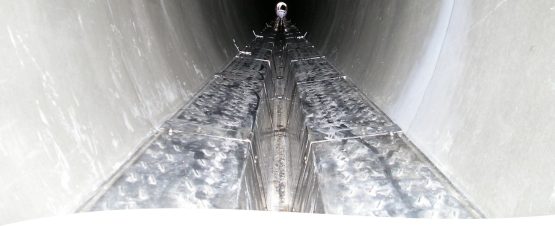
- Furthermore, it is clearly regulated that the installation of heat exchangers in the channel does not reduce the diameter by more than 10% in order not to jeopardize the proper flow.
You can request further details from us or you can find them in ÖWAV Arbeitsbehelf 65.
YES, in many cases this is absolutely necessary to ensure optimal operation.
Basically, a distinction is made between
- Monovalent mode of operation of the heat pump: Energy from waste water is used as an environmental energy source and, together with the auxiliary energy source of the heat pump, supplies the heating and cooling system. In this way, independence from fossil fuels can be achieved.
- Bivalent or multivalent operation of the heat pump: In addition to the thermal energy of the waste water, one or more other energy sources are used to cover peak loads (e.g. district heating to cover peak loads in winter). Under certain circumstances, this enables more economical operation through smaller dimensions.
Furthermore, one should always consider the use of photovoltaic systems as a power supplier for the heat pump – depending on the project with or without the use of battery or storage systems.
The Austrian Water Law Act WRG 1959 is the legal basis for the permit requirement.
Agreements under private law must be made for the use of waste water by third parties. These regulate, among other things, terms of use, contract duration and disclaimers.
In the legal clarification with the sewer network operator, the private law and other agreements, rabmer GreenTech GmbH is happy to support you with expertise from projects that have already been implemented.
Energy from wastewater is CO2-free. Only the necessary heat pump electricity has to be taken into account on the CO2 side, whereby this can largely be produced with renewable PV systems. If you consider that the general electricity mix is also becoming greener every day, energy from wastewater will be completely CO2-free in the medium term, even with a conventional electricity mix.
In principle, the operator of a waste water heat utilization plant only needs the approval of the sewage network operator. The sewer network operator decides whether or not a system for generating energy from wastewater may be installed in a specific sewer. For sewer network operators, as the carrier of a sovereign task, it is crucial that the sewer operation is not restricted in any way by the energetic use of the wastewater. That’s exactly what will happen. also regulated and ensured by the ÖWAV Arbeitsbehelf 65. As a company that has been active in sewer construction for more than five decades and has specialized in the implementation of waste water energy systems, we are very familiar with the requirements in the sewer. With the help of a user agreement, all parameters are defined before a system is commissioned, e.g. the service life, the basic technical conditions and the user fee to be paid. We are happy to provide templates for such user agreements.
In the used sewer section, there is no higher cleaning, maintenance or control effort for the sewer network operator.
Rabmer uses the best technologies available on the market and makes the project-specific decision as to which is best suited. We work together with the leading technology providers in this area, such as the company Uhrig when using heat exchanger systems installed in the duct, or the company Thermowatt, which specializes in bypass solutions (external heat exchanger bundles) for large systems > 1 MW. Heat pumps are also requested and implemented on a project-specific basis from the leading producers as part of the project planning. For in-house solutions, we use heat exchanger solutions from primarily Austrian providers.
The installation of the heat exchanger is based on the associated specifications of the ÖWAV issuer of regulations. The specifications are defined in the ÖWAV working aid 65.
The heat exchanger modules from the company Uhrig installed in the duct are not concreted in, for example, but fixed with so-called “hold-down devices”. Hold-down devices are clamps that are attached to the canal wall using an HKD expansion anchor. The maximum drilling depth is 40mm, hole diameter 12mm. The screw connection is flush with countersunk screws (DIN 7991 M10x25). All fastening elements are made of material quality 1.4404 to avoid interactions. The elements and connecting parts are secured against dirt and damage by deflector plates. These deflector plates and the cladding of the supply and return lines are also made of the material 1.4404. The transition areas from the bottom of the channel to the first and last element are each secured by ramps in and out, so that no coarse materials can get caught. The ramps are also made of 1.4404 stainless steel.
When using bypass technologies, a removal shaft is built project-specifically in the immediate vicinity of the sewer, through which the waste water is transported to the heat exchanger systems placed in a technical room. You are welcome to ask our specialists for details.
Heat exchangers can also be installed in waste water pressure lines. In these lines, the energetic yield is always particularly high. The only disadvantage compared to the normal channels, the so-called gravity channels, is that the installation of the heat exchanger requires civil engineering work. Sewage pressure lines have to be uncovered, usually an entire section of a pressure line is replaced by a new line section with an integrated heat exchanger system. In the case of a new construction or the renovation of a pressure line, this approach is always highly attractive from an economic point of view. If neither new construction nor refurbishment is planned, then the extent of the civil engineering work is decisive for an evaluation of the profitability. This scope differs in each project. Since gravity channels are accessible from a certain size, the installation of the heat exchanger does not require any civil engineering work here. This is what makes the system so attractive in principle, especially in urban areas where, due to the lack of open space, many renewable energies are only a very limited option as a supply option.
Sewer network operators perform a sovereign task, the waste water management. Trouble-free operation has the highest priority, so heat exchangers in the sewer are only approved if they do not impose any restrictions on sewer network management. We meet this requirement with our solutions.
In Germany and Switzerland, the sewer network operators now approve the installation of sewer heat exchangers, with Berlin and Zurich being absolute pioneers. A rethink has also taken place in Austria, especially since the ÖWAV Arbeitsbehelf 65 was published. Vienna plays a clear pioneering role here, but many other cities such as Graz, Linz, Baden or Wiener Neustadt as well as many municipalities and sewage associations have recognized the many advantages and are dealing intensively with this topic.
A frequent reservation of the sewage network operators used to be the cooling of the waste water by the energy extraction. It is correct that heat energy is extracted from the waste water when using waste water heat and the waste water is cooled in the immediate vicinity of the heat exchanger. But it also regenerates quickly, through the inflow of new sewage and through the absorption of ambient heat through the canal. As a rule of thumb: A plant for generating energy from waste water then needs about two to three times the length of the plant itself as a recovery section, then the waste water has regenerated itself again on the temperature side. If a system is 100 meters long, the waste water will have been regenerated energetically after 200 to 300 meters at the latest. From this it follows that for the sewage treatment plants, which usually require a minimum temperature of the sewage of 8 – 10 °C, the only decisive factor is how much heat the last plant before the sewage treatment plant extracts from the sewage and how far away it is from the sewage treatment plant. The energy consumption in the network in front of it is irrelevant for the sewage treatment plants. The waste water cooling is therefore not a limitation for the generation of energy from waste water.
Most projects are now being implemented under contracting, so that the end customer is offered a fixed price in ct/kWh for heating or cooling. This offers transparency and high price stability. If desired, customers have nothing to do with the operation or purchase of the system, but obtain heat and/or cold “all-round carefree” at a fixed price. We would be happy to support you in your search for a suitable contracting partner.
More info
Or request personal advice